
How to Choose the Right Concrete Floor Coating for Your Lifestyle and Space
Concrete floor coatings are not a one-size-fits-all product. The right system for a busy two-car garage looks different from the right system for a finished basement or a commercial workspace. Choosing the right concrete floor coating means thinking through how you use the space, what conditions the floor faces, and what you want it to look like when the project is done.
Choosing the right concrete floor coating starts with understanding those variables clearly before you commit to anything. At Alexander Concrete Coatings, we walk every homeowner through this process before installation begins. Here's the framework we use.
Step One: Start With How You Actually Use the Space
The single most important factor in coating selection is how the space functions day to day. A floor that sees light foot traffic a few times a week has very different requirements from one that handles vehicle weight, power tools, and daily use.
Think honestly about what happens in the space:
Does it see vehicle traffic? Tires, oil drips, and the weight of a car or truck place significant demands on a coating system that a foot-traffic-only floor doesn't.
Is it a multi-purpose space? A garage that doubles as a home gym or workshop needs a coating that holds up to both, not just one or the other.
Will children or pets use the space regularly? Durability and ease of cleaning become more important in high-activity family spaces.
Is the space temperature-controlled? Unheated garages and below-grade basements experience more temperature fluctuation, which affects how a coating performs over time.
Being specific here makes every other decision easier. A general sense of "I use the garage sometimes" is less useful than knowing you park two vehicles, run a compressor occasionally, and want the floor clean enough to walk on barefoot in summer.
Step Two: Match the Coating System to the Space
Not every coating system is built the same way, and understanding the differences is a big part of choosing the right concrete floor coating for your specific situation.
Epoxy
Epoxy has been used on concrete floors for decades. It bonds to the surface and provides a hard finish that looks clean when freshly applied. The limitation is that epoxy is rigid. According to the U.S. Department of Energy, concrete naturally expands and contracts with temperature changes, and coatings that don't flex with that movement are more likely to fail over time. In Ohio and Western Pennsylvania, where temperatures swing significantly between seasons, this is a real consideration.
Polyurea and Polyaspartic
Polyurea and polyaspartic coatings are the current performance standard for professional concrete floor systems. They are flexible, which means they move with the concrete rather than resisting it. They cure faster than epoxy, bond directly to prepared concrete, and hold up significantly better over time in climates like ours.
Alexander Concrete Coatings installs Penntek's complete polyurea and polyaspartic system — four times stronger than traditional epoxy. We are the only authorized and certified Penntek installer in the Youngstown area and Western Pennsylvania.
What the System Includes
A professional coating is a layered system, and understanding what goes into it helps you evaluate quality:
Surface preparation: mechanical diamond grinding to open the concrete and ensure maximum adhesion. This step determines how well the entire system bonds and how long it lasts. Any existing coating or paint must be fully removed down to bare concrete first.
Polyurea basecoat: bonds directly to the prepared concrete and provides the flexible structural foundation of the system.
Decorative flake layer: color flakes broadcast into the wet basecoat add visual depth and natural surface texture. A grip additive is also broadcast into the topcoat on most garage installations and is required on all exterior surfaces.
Polyaspartic topcoat: a UV-stable finish layer that protects the system, delivers the finished surface, and keeps color consistent over time.
When evaluating any coating system, ask whether all four layers are included and how surface preparation is handled. A coating applied to poorly prepared concrete will not hold up regardless of product quality.
Step Three: Think About the Look You Want
Performance is the priority, but appearance matters too — especially in spaces that are highly visible or used as living areas. A finished basement, a showroom-quality garage, or a home gym should look intentional.
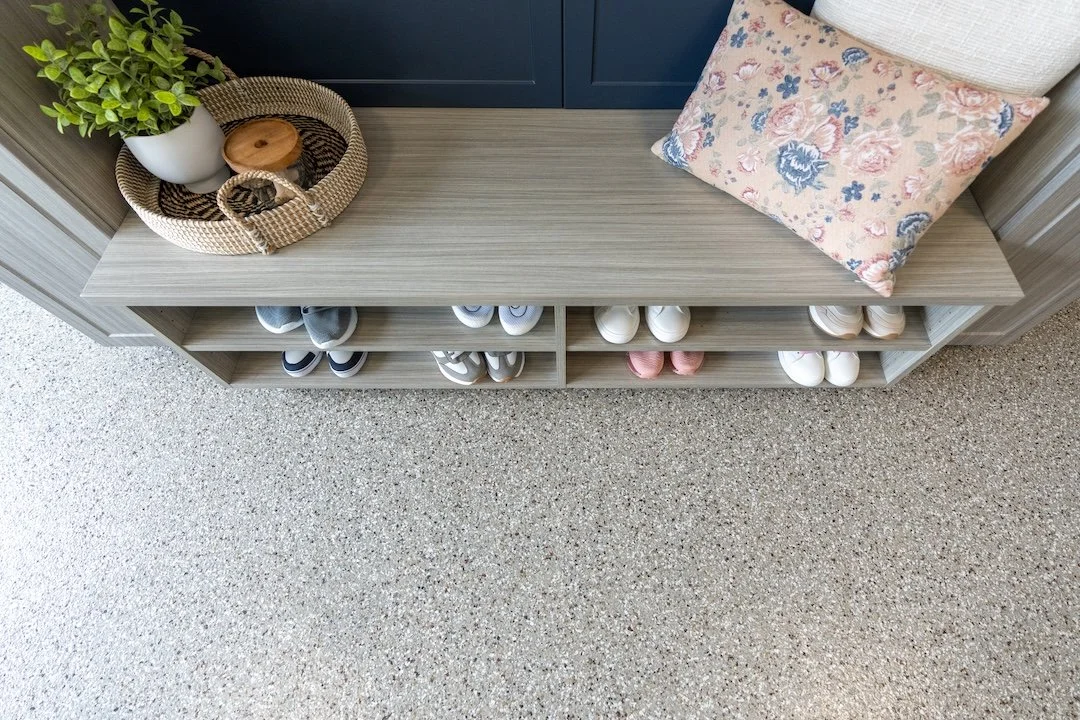
Alexander Concrete Coatings offers a wide range of decorative flake combinations through the Penntek system. Options range from understated neutrals that complement most homes to bolder, high-contrast blends that make the space feel like a finished room. We bring samples to every estimate so you can see the options in your actual space before committing.
Step Four: Consider Long-Term Maintenance
One of the most underrated factors in choosing the right concrete floor coating is how much ongoing maintenance the system requires. Some coatings look great on day one but demand regular resealing, specific cleaning products, or periodic repairs to stay in good condition.
A professionally installed polyurea and polyaspartic system is designed to be genuinely low-maintenance:
Day-to-day: a quick sweep handles most situations
Periodic cleaning: a mop with a standard household cleaner is sufficient
No resealing required over time
No special cleaning products needed
For homeowners who want to use a space rather than maintain it, this is a significant practical advantage over epoxy, tile, or bare concrete.
Step Five: Understand the Installation Timeline
Knowing what to expect from installation helps with planning, especially when the space is in active use.
Most Alexander Concrete Coatings installations are completed in a single day. After the coating is applied:
12 hours: the floor is walkable
24 hours: lighter items can be placed back in the space
36 hours: the space is back to full use
That timeline means minimal disruption. For a garage, it typically means one day without vehicle access. Most homeowners find the turnaround faster than they expected.
Common Spaces and What to Look For
Garages
Garages are the most common application. A good garage coating needs to handle vehicle weight, resist oil drips, and hold up through temperature swings in an unheated space. Polyurea and polyaspartic systems are well-suited here because of their flexibility and durability under those conditions.
Basements
Below-grade spaces face humidity and temperature changes that above-ground floors don't. A coating that bonds directly to the concrete and flexes with it is essential. According to the EPA, moisture testing before any coating application is recommended for below-grade concrete surfaces. Finished basements also benefit from the visual range that decorative flake systems offer, since the space is often used as a living area.
Workshops and Utility Spaces
Workshops see heavy equipment, tool use, and frequent messes. Easy cleaning and long-term durability are the priorities. A seamless coated surface handles these demands better than bare concrete, which absorbs stains and is harder to keep clean.
Multi-Purpose Spaces
Many homeowners use a single space for more than one purpose: a garage that's also a home gym, a basement that's also a home office. A coating system that balances durability with a finished appearance serves these spaces best.
Ready to Choose the Right System for Your Space?
The process is easier when you have the right information and the right partner. At Alexander Concrete Coatings, we guide every homeowner through the process — from evaluating the space to selecting the finish — so the floor they end up with is built for how they actually live.
Every residential installation comes with a limited lifetime warranty. Most projects are done in a single day, and your floor is back to full use in 36 hours.
Contact us to schedule your free on-site estimate.
Frequently Asked Questions
How do I know which coating system is right for my garage versus my basement?
The biggest difference is moisture. Basement concrete is below grade and more susceptible to moisture vapor, which affects how coatings bond. We test for moisture as part of every free estimate. For both spaces, the Penntek polyurea and polyaspartic system is the right choice — the flexibility handles temperature fluctuation in a garage and the moisture tolerance holds up in a basement.
Do I need to do anything to prepare my space before installation?
Clear the floor completely — vehicles, equipment, and stored items. We handle everything from there, including grinding the concrete down to bare and removing any existing coatings before we begin.
Can I choose a custom color or flake combination?
Yes. We offer a wide range of flake blends and bring samples to every estimate so you can see them in your actual space. Lighting and surroundings affect how colors read, and seeing them in person makes the decision much easier than choosing from a photo.
What questions should I ask any coating contractor before hiring them?
Ask how they prepare the surface, what materials they use in the basecoat and topcoat, whether the topcoat is UV-stable, and what the warranty covers. The surface preparation question is the most important — mechanical diamond grinding is the standard, and anything less is a shortcut that affects long-term performance.
How long does the coating last?
A Penntek polyurea and polyaspartic system is built for decades of use and backed by a limited lifetime warranty on residential installations. Proper surface preparation and a complete layered system are the keys, and both are standard on every job we do.